
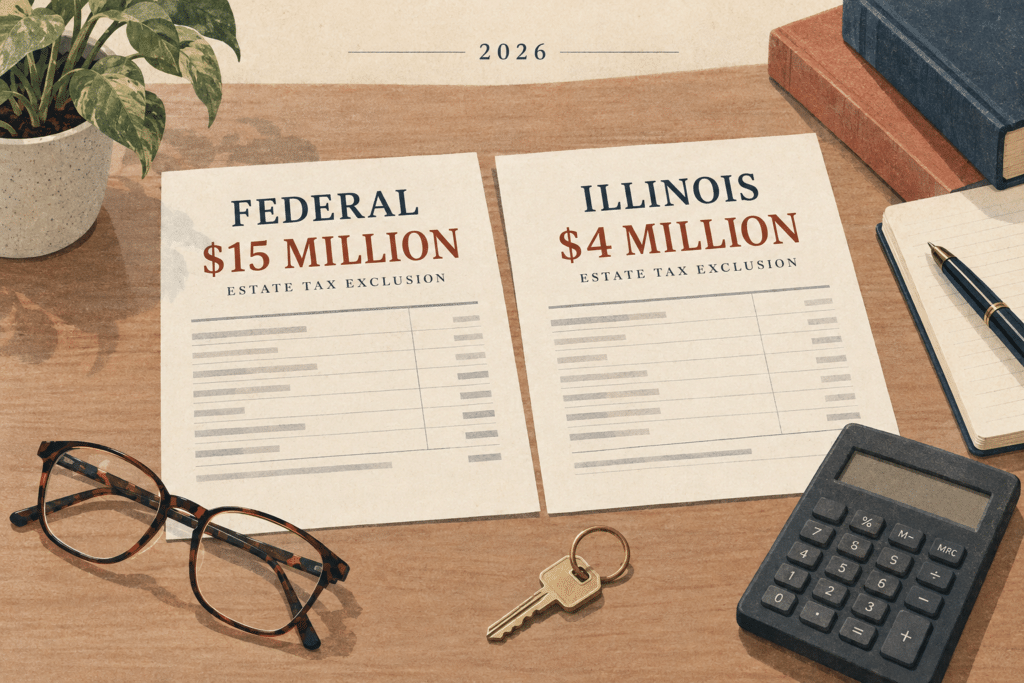
Illinois Estate Tax in 2026: Why the $15 Million Federal Exemption Is Only Part of the Story
By: Robert J. Varak, Naperville Estate Planning Attorney
November 17, 2026
That difference deserves attention as you review your finances before the end of the year.
A family may have most of its wealth in a home, retirement accounts, and life insurance. Those assets can create estate tax exposure even when the family does not think of itself as wealthy.
In my Naperville estate planning practice, I encourage clients to review both the value of their assets and how those assets will pass.
What Is the Illinois Estate Tax Exemption in 2026?
Illinois continues to use a $4 million exclusion. Its estate tax system operates separately from the federal system.
The Illinois Attorney General explains that an estate’s gross value, including adjusted taxable gifts, can trigger an Illinois filing requirement above $4 million even when no federal estate tax return is otherwise required.
The Illinois calculation is also more complicated than applying a flat percentage to the amount above $4 million. The exclusion is a taxable threshold, and the state uses an interrelated calculation.
The Attorney General provides estate tax instructions and a calculator for evaluating the applicable rules.
What Counts Toward Your Estate?
Your estate tax review should extend beyond your checking and investment accounts.
Depending on ownership and applicable tax rules, the calculation can include interests in:
- Your home and other real estate.
- IRAs, 401(k)s, and other retirement benefits.
- Brokerage and bank accounts.
- Business interests.
- Life insurance proceeds.
- Property held in your revocable living trust.
For illustration, a home worth $900,000, retirement accounts totaling $2.4 million, and other investments of $800,000 add up to $4.1 million before considering insurance, debts, ownership allocation, or other adjustments.
That is a reason to investigate exposure. It is not a tax calculation, and a married couple’s combined assets must be analyzed according to each spouse’s ownership and plan.
Avoiding Probate Does Not Automatically Avoid Estate Tax
An asset can pass outside probate and still be included in an estate for estate tax purposes.
This is a common source of confusion. Naming a beneficiary on an IRA may avoid probate for that account. Moving your home into your revocable living trust may avoid probate for the home. Neither step, by itself, removes the asset from your taxable estate.
A revocable trust can contain provisions designed to support estate tax planning. The tax result depends on those provisions, ownership, beneficiary designations, and administration.
I address these issues through my Illinois estate tax planning services.
Married Couples Should Review What Happens at the First Death
Federal law permits a portability election that can preserve a deceased spouse’s unused federal exclusion for the survivor. That generally requires an estate tax return and compliance with the election rules.
Illinois does not provide the same carryover.
Leaving everything outright to the surviving spouse may postpone a tax issue while concentrating assets in the survivor’s estate. Appropriately designed trusts can help address that concern.
Depending on your circumstances, planning may involve separate revocable trusts, a credit shelter trust, or marital trust provisions. The right structure must also account for your spouse’s access to funds, future appreciation, income taxes, and administration.
Creating two documents labeled “trust” does not automatically preserve both Illinois exclusions.
Review Retirement Beneficiaries Before Making Changes
Retirement accounts require particular care because estate tax planning and income tax planning intersect.
Naming your spouse, children, or trust as beneficiary can produce different outcomes. A trust may provide control or protection that an outright designation would not, but its terms can also affect how retirement benefits must be distributed.
Do not change an IRA beneficiary to your trust simply because the trust is the center of your estate plan.
Instead, review the actual beneficiary forms with your attorney and financial adviser. Confirm primary and contingent beneficiaries, the intended shares, and whether the designation supports the trust’s tax provisions.
A Practical Year-End Estate Planning Review
Before the end of 2026, gather your current account statements, insurance information, deeds, beneficiary confirmations, and signed estate planning documents.
Then consider five questions:
- What do I own today? Use current values rather than the estimates from your original planning meeting.
- How is each asset titled? A trust provision cannot accomplish its purpose if ownership defeats the intended funding.
- Where does each beneficiary form send the money? Include contingent beneficiaries.
- What happens at the first spouse’s death? Understand which trusts must be funded and who will handle that work.
- Can my chosen decision-makers still serve? Review successor trustees and agents under your powers of attorney.
Year-end is a useful reminder to review these items. There is no general December 31 deadline to create a revocable trust, and gifts or ownership changes should follow an analysis of their consequences.
Frequently Asked Questions
Did the higher federal exemption eliminate Illinois estate tax?
No. The 2026 federal basic exclusion is $15 million per person. Illinois continues to use its separate $4 million exclusion.
Does a married Illinois couple automatically receive an $8 million exemption?
No. Each spouse’s exclusion requires appropriate planning. Illinois does not automatically transfer the first spouse’s unused exclusion to the survivor.
Will my living trust eliminate estate tax?
Not automatically. Probate avoidance and estate tax planning are separate goals. Your trust’s provisions and the way you fund the plan determine what it can accomplish.
Reviewing Your Estate Plan in Naperville
You do not need to know whether you have a tax problem before scheduling a review. Identifying that exposure is part of the planning process.
I help clients in Naperville and the surrounding western suburbs evaluate their wills, trusts, ownership arrangements, and beneficiary designations together. If your assets have grown or your plan was drafted under older assumptions, contact me to discuss whether it needs attention.