
Estate planning is one of those things many people put off, often because of misconceptions about who needs it, how complicated it is, or what it actually does. As a will and trust lawyer in Naperville, I see the effects of those myths all the time. People delay planning for years, only to discover later that the misunderstandings they relied on left their families exposed to avoidable legal and financial problems.
The good news is that estate planning is usually more straightforward, and more useful, than people expect.
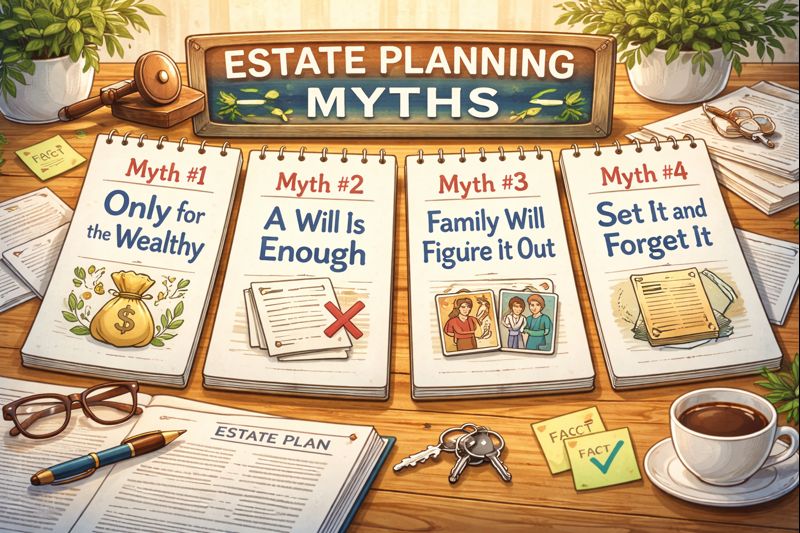
Myth 1: Estate planning is only for the wealthy
This is probably the most common estate planning myth.
Estate planning is not just about passing along large amounts of wealth. It is also about making decisions. Who would care for your minor children if something happened to you? Who would make medical decisions if you could not speak for yourself? Who would handle your finances during incapacity? Those issues matter whether your estate is large, modest, or somewhere in between.
Without a plan, Illinois law will fill in the blanks. The people making decisions, and the people inheriting property, may not be the people you would have chosen.
Myth 2: A simple will is enough
A will is important, but it is not a complete estate plan by itself.
A will helps direct how certain assets pass at death, but it does not control everything. Assets with beneficiary designations, such as retirement accounts and life insurance, generally pass according to those designations, not according to the will. A will also does not solve the problem of incapacity during life.
A more complete plan usually includes powers of attorney, health care documents, and sometimes a trust. Those pieces work together. A will alone usually does not.
Myth 3: My family will work things out
Many people believe their loved ones will handle everything peacefully, even without clear written instructions. Sometimes that happens. Sometimes it does not.
Grief, stress, and uncertainty can magnify misunderstandings very quickly. When there is no clear direction about who should be in charge, who should receive what, or what the deceased person actually intended, even close families can run into conflict.
Clear legal documents reduce ambiguity. They make it easier for family members to focus on supporting one another instead of arguing over guesses and assumptions.
Myth 4: Once an estate plan is signed, it never needs to be revisited
Estate plans should change as life changes.
Marriage, divorce, births, deaths, moves to a new state, health issues, retirement, and major changes in finances can all affect how a plan should work. An outdated plan can create real problems, especially when beneficiary designations, fiduciary appointments, or distribution instructions no longer match your current circumstances.
A good estate plan is not something you do once and forget forever. It should be reviewed from time to time so it still fits your life.
Why these myths matter
Believing estate planning myths often leads to inaction. That is the real danger.
The delay usually is not caused by a legal obstacle. It is caused by false assumptions. People think they do not need a plan yet. Or they assume the documents they signed years ago must still be fine. Or they believe a basic will covers everything when it does not.
In reality, creating or updating an estate plan is often much more manageable than people expect, especially with professional guidance.
As a will and trust lawyer in Naperville, I think one of the most valuable parts of the process is simply clearing away the noise. Once people understand what estate planning actually does, and what it does not do, it becomes much easier to move forward with confidence.
Key takeaways
Estate planning is for everyone, not just the wealthy.
A will is important, but it is only one part of a complete plan.
Clear documents help reduce family conflict.
Estate plans should be reviewed as life changes.